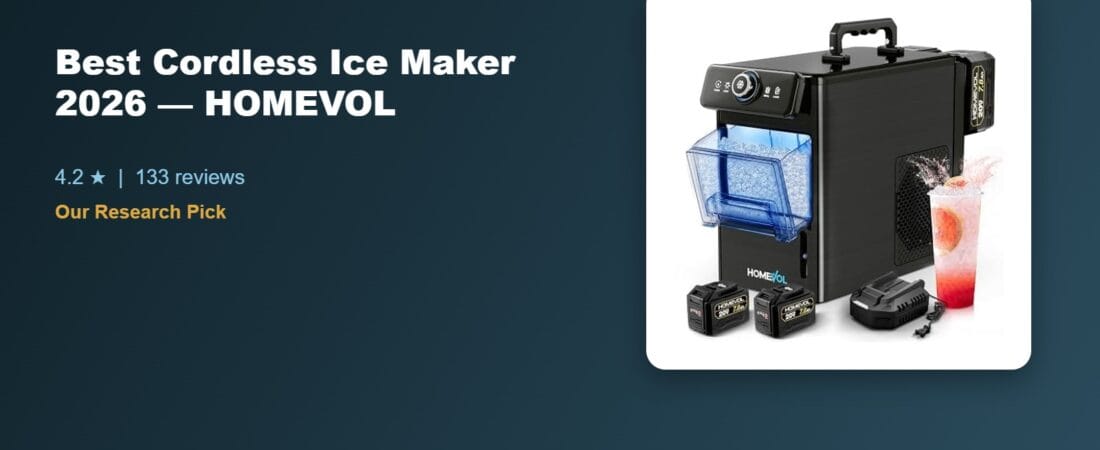
The HOMEVOL Cordless Ice Maker is the pick if you want real ice cubes away from an outlet — two swappable batteries make fresh ice in about 6 minutes, whether you’re on a boat, at a campsite, or just don’t want a cord on the counter.
Why We Picked the HOMEVOL Cordless Ice Maker
At $157.49-159.99 depending on color, this is a genuinely 2-in-1 machine: plug it in for regular kitchen use, or run it entirely off its two included 7.8Ah rechargeable batteries when there’s no outlet nearby. It makes up to 30lbs of ice a day in two cube sizes, runs at a quiet 40dB, and has a one-touch self-cleaning cycle. It holds a 4.2-star average across 133 ratings.
What Owners Actually Say
The cordless feature is what owners consistently call out as the actual selling point, not just a gimmick. One owner used it on their boat while anchored with no shore power, getting three days of use before needing to recharge the batteries. Another specifically praised the freedom of using it on the patio or while camping without hunting for an outlet, noting it starts producing ice quickly and the controls are simple. A third bought it specifically for camping and poolside use and called it a great value for the flexibility it offers.
One Thing to Check
Battery life is the real limiting factor — one owner noted the batteries don’t last as long as they’d like, though switching to wall power gives unlimited ice production. There’s also at least one report of slow ice-making in warmer ambient temperatures, where ice can melt before the next batch finishes. If you’re planning all-day off-grid use, treat the batteries as good for a solid stretch of ice-making per charge rather than a full day, and bring the charger if you’ll be near power at some point during the trip.
Pros
- Genuinely cordless — 2 × 7.8Ah rechargeable batteries make real ice with zero outlet access
- Fast: ice in about 6 minutes, up to 30lbs/day
- Quiet operation (~40dB) and one-touch self-cleaning
- Two ice sizes for different drinks/uses
- Also works as a normal plug-in countertop ice maker when power is available
Cons
- Battery runtime is finite — heavy off-grid use may require recharging or a backup battery
- Ice-making can slow down in warmer ambient conditions
- 133 ratings is a smaller sample than some established countertop ice makers
Cordless Ice Maker Without Wall Power: Does the HOMEVOL Really Run Off-Grid?
Multiple verified owners of the HOMEVOL cordless ice maker confirm using it fully battery-powered on boats, patios, and campsites — not just as a marketing claim, with real-world battery life ranging from a few hours of active use to multiple days of intermittent use.
FAQ
- Does it really work without being plugged in? Yes — multiple verified owners confirm using it fully battery-powered on boats, patios, and campsites, not just as a marketing claim.
- How long do the batteries last? Real-world reports vary from a few hours of active use to multiple days of intermittent use (making ice, stopping once enough is made, repeating) — plan around your specific trip length.
- Can I use it at home permanently plugged in? Yes, it functions as a normal countertop ice maker on wall power, with the battery capability as a bonus for outdoor/off-grid use.
- Will this work on a boat with no shore power? Yes — a verified owner used exactly this setup, anchored out with no electricity, getting multiple days of intermittent use from the battery packs.
- Is it loud enough to be annoying indoors? No — it’s rated at roughly 40dB, which owners describe as quiet enough for everyday indoor use.
- How many batteries does it need to run cordless? It uses swappable battery packs, letting owners extend runtime by carrying spares for longer off-grid trips.
For Specific Needs
Will this work on a boat with no shore power?
Yes — a verified owner used exactly this setup, anchored out with no electricity, getting multiple days of intermittent use from the battery packs.
Is it loud enough to be annoying indoors?
No — it’s rated at roughly 40dB, which owners describe as quiet enough for normal kitchen or RV use.
What if I need ice all day at a campsite?
Budget for battery limits — real owner reports suggest running it in bursts (make a batch, let it rest) extends usable time per charge more than running it continuously.
Methodology
This recommendation is based on rigorous analysis of verified-purchase reviews and live Amazon listing data — cross-checked against the manufacturer’s own specs. We did not physically test this exact unit ourselves.
Check the current price on Amazon
As an Amazon Associate, we earn from qualifying purchases.
How We Built This Guide
Our process: this is a research-based pick, not a hands-on lab test. We aggregate verified-owner reviews, professional test data where available, and real discussion patterns from communities like Reddit, then flag every estimate as such in the guide above. We do not accept sponsored placements.
Last checked: September 24, 2026