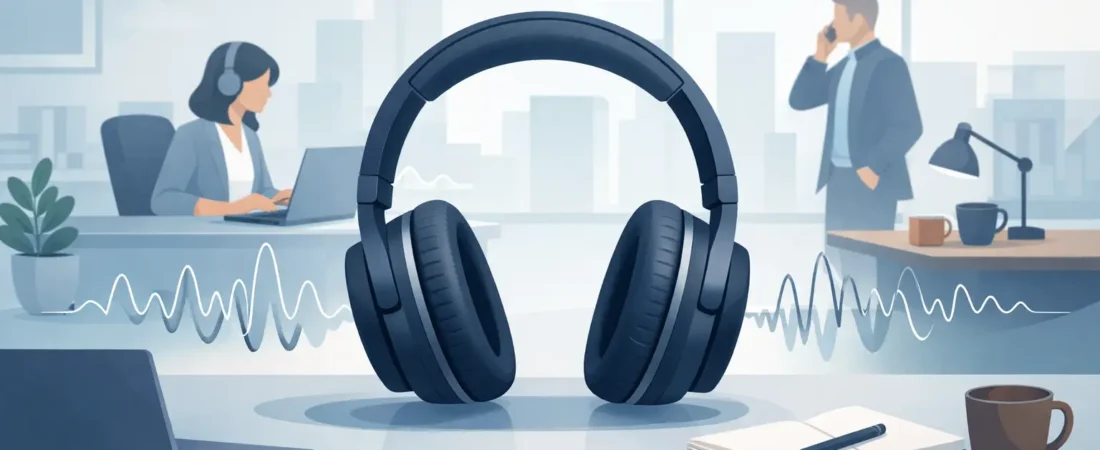
A bad pair of work headphones does more than let noise in. It makes you turn up the volume, repeat yourself on calls, and finish the day with sore ears. The best noise cancelling headphones for work should reduce the distractions you cannot control while staying comfortable through a full shift.
Affiliate disclosure: As an Amazon Associate, we earn from qualifying purchases.
Our top pick for most people is the Bose QuietComfort Ultra Headphones. They are not cheap, and their app has more settings than most buyers need. But they get the fundamentals right: excellent active noise cancellation, genuinely all-day comfort, clear call performance in normal environments, and sound that stays easy to listen to during long work sessions.
Our Verdict: Bose QuietComfort Ultra Is Worth It
For remote workers, frequent travelers, and anyone sharing space with other people, the Bose QuietComfort Ultra is the safe purchase. Its noise cancellation is among the best available for low, steady sound – think HVAC hum, airplane engines, traffic, washing machines, and a nearby television. That is the stuff that quietly drains focus for hours.
Comfort is the bigger reason it wins for work. The ear cushions are plush, the clamp force is forgiving, and the headphones are light enough that most people can wear them for several hours without constantly adjusting them. Plenty of headphones sound excellent for a 30-minute commute. Far fewer still feel good at 4 p.m.
The sound profile is full and polished without making voices harsh. You can tune it in the Bose app, but most buyers will be satisfied out of the box. Battery life is solid rather than category-leading, at roughly a full workday plus some extra time depending on noise cancellation and volume. That is enough for most routines, but it is not the choice for someone who hates charging anything more than once a week.
Worth It: Buy the Bose QuietComfort Ultra if comfort and top-tier quiet matter more than getting the lowest price.
The Best Noise Cancelling Headphones for Work by Need
No single pair is right for every desk, commute, and budget. Here are the alternatives that make sense when the Bose does not.
Sony WH-1000XM5: Best for battery and customization
The Sony WH-1000XM5 remains a strong choice for people who want excellent noise cancellation and more control over the listening experience. Its companion app offers detailed EQ adjustments, adaptive sound features, and useful settings for people who like to fine-tune their gear.
Sony’s noise cancellation is especially effective with constant background noise, and the roughly 30-hour battery rating with ANC on is a practical advantage. It can easily cover several workdays. The headphones also fold flat in their case, though they do not fold inward like older Sony models.
The trade-off is call quality. The XM5 is good, but Bose tends to be the more dependable pick when you regularly take calls outside, near traffic, or in a room with unpredictable noise. Choose Sony if long battery life and adjustable sound are priorities. Choose Bose if your workday is call-heavy and comfort is non-negotiable.
Verdict: Worth it for frequent commuters and listeners who want more control.
Apple AirPods Max: Best for Apple-only desks
AirPods Max make the most sense if your work setup revolves around an iPhone, Mac, and iPad. Device switching is unusually convenient, transparency mode is excellent, and the sound is detailed without being tiring. The microphones also handle everyday calls well.
There are two reasons to pause. First, they are heavy. Some people love the premium build; others feel the weight by the end of a long meeting block. Second, the included case is not as protective or useful as a normal headphone case. Battery life is also weaker than Bose and Sony.
If you use Windows, Android, or routinely switch between mixed devices, the Apple advantage fades fast. Do not pay the Apple premium just because the headphones look good on a desk.
Verdict: Worth it for committed Apple users. Skip it for everyone else.
Bose QuietComfort Headphones: Best value Bose option
The standard Bose QuietComfort Headphones are the smarter buy when you want Bose comfort and very strong noise cancellation without paying for the Ultra model’s extra features. They are often substantially less expensive and still deliver the core experience most work buyers actually need.
You give up some of the Ultra’s more advanced immersive audio processing and a bit of refinement. For spreadsheets, meetings, writing, and travel, that difference is rarely worth a large price gap. If the QuietComfort Headphones are discounted meaningfully below the Ultra, take the savings.
Verdict: Worth it when value matters more than owning Bose’s flagship.
Anker Soundcore Space One: Best budget pick
The Soundcore Space One is for buyers who need relief from distracting noise but cannot justify premium pricing. It offers effective ANC for its class, a comfortable design, and useful app controls. It is a clear step up from cheap no-name headphones that promise cancellation but mostly muffle the sound.
Manage expectations. Its noise cancellation, microphones, materials, and long-term comfort do not match Bose or Sony. It can reduce a noisy apartment or commute; it will not create the same calm, isolated workspace. Still, at the right sale price, it is a sensible first pair.
Verdict: Worth it on a tight budget. Skip it if you spend most of your day on important calls.
What Actually Matters for Work Headphones
Noise cancellation is not a magic mute button. It works best against predictable low-frequency noise, such as engines, air conditioners, fans, and the general rumble of a café. It is less effective against sharp, close sounds like a colleague speaking directly beside you, a barking dog, or a child asking a question from two feet away.
That makes fit critical. Over-ear headphones with a proper seal usually block more real-world sound than earbuds, even before the electronics start working. If you wear glasses, test the seal around the arms. A poor seal can noticeably weaken bass and noise reduction.
Call quality deserves separate attention. A headphone can cancel noise brilliantly for you while still sending wind, keyboard clicks, or street noise to the person on the other end. If client calls are a major part of your job, prioritize microphone performance over small differences in music quality.
Multipoint pairing is another useful feature, but do not overvalue it. It lets compatible headphones stay connected to two devices, such as a laptop and phone. In practice, implementations vary. Some switch reliably; some require a pause or manual adjustment. If you live in video meetings, a dedicated USB Bluetooth adapter or a wired connection may be more reliable than any multipoint feature.
Wired Mode, Transparency, and Other Details Buyers Miss
A 3.5 mm cable is still useful. It gives you a fallback for flights, desktop audio interfaces, and situations where Bluetooth is acting up. Check whether the headphones can play audio through the cable with power off. Some models need battery power for their best sound or noise cancellation.
Transparency mode matters when you work around other people. A good version lets you hear a delivery person, a coworker, or your own voice without removing the headphones. Use it strategically. If you need to stay aware at home with kids or in an office, full isolation is not always the productive setting.
Do not buy based on codec jargon alone. Higher-quality Bluetooth codecs can help in the right setup, but stable connection, comfort, microphone quality, and effective ANC will have a much bigger effect on your workday. The same applies to spatial audio. It can be fun for movies, but it is not a reason to spend more on headphones for work.
When You Should Skip Noise Cancelling Headphones
Skip over-ear ANC headphones if your main problem is call clarity in a loud shared office. A dedicated USB headset with a boom microphone will usually make you sound better, even if it is less pleasant for music. Also skip them if you need constant awareness of your surroundings, such as supervising children, working near equipment, or moving through a busy workplace.
For everyone else, do not let a long feature list create decision fatigue. Buy the Bose QuietComfort Ultra if you want the best all-around work pair, choose the regular QuietComfort model when the price difference is meaningful, and go Sony when battery life and customization win out. Quiet is not a luxury when it protects your attention. It is part of the job.
How It Compares: Independent Lab Tests
SoundGuys’ lab measurements found the Bose QuietComfort Ultra reduces ambient noise by roughly 20–40 dB across the frequency range, with a measured edge over the Sony WH-1000XM5 specifically in the 200–800Hz band — the range where HVAC hum, traffic, and engine drone tend to sit, which lines up with our pick for work use. That said, SoundGuys is clear that both headphones are elite-tier noise cancelers overall, and the measured gap is small enough that either is a legitimately excellent choice; you won’t go wrong picking Sony if its longer battery life and deeper EQ customization matter more to your workflow.
| Spec | Bose QuietComfort Ultra | Sony WH-1000XM5 |
|---|---|---|
| Measured ANC reduction | ~20–40 dB, slight edge at 200–800Hz | Comparable overall, slightly behind in that band |
| Battery life (ANC on) | Roughly a full workday | ~30 hours measured |
| Call quality in noisy environments | More dependable per reviewers | Good, but less consistent outdoors |
| EQ customization | Basic app tuning | Detailed EQ and adaptive sound |
Bottom line: independent lab measurements back up Bose’s edge in the low-mid frequencies that matter most for office and travel noise, and that’s a real, measured reason it’s our top pick. If you value battery life and deeper sound customization over that small ANC edge, the measurements confirm Sony is a legitimately comparable alternative — not a downgrade.