This pick is based on live Amazon listing data and a close read of verified-purchase reviews — not hands-on testing of this exact unit. Here’s what we found.
Why We Picked the ARZOPA A1
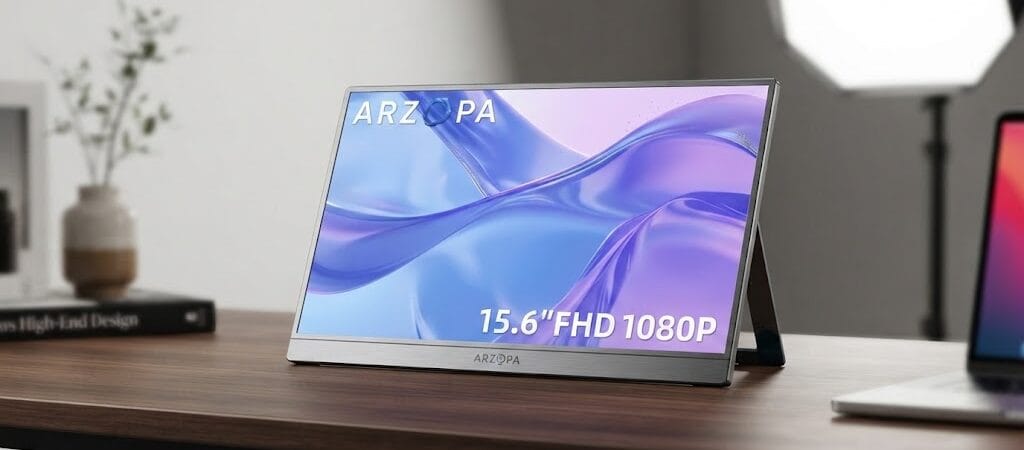
The ARZOPA A1 (15.6″, FHD 1080P, USB-C/HDMI) is one of the most consistently well-reviewed portable monitors in its price bracket: 4.6 stars across 3,002 ratings, Amazon’s Choice, and roughly 400+ bought in the past month. At $79.99 it sits comfortably in the “useful travel accessory” range rather than the “second thoughts at checkout” range, and it does the one thing people actually want from this category — plug in over a single USB-C cable and get a second screen, no drivers, no software.
It’s built for the specific use case that keeps coming up in reviews: remote workers and travelers who want real dual-monitor productivity without carrying a proper monitor. A built-in kickstand, 1.6 lb body, and 0.35-inch profile make it something you’d actually pack, not just own.
What Owners Actually Say
Reviewers who’ve had it for months, not days, are the most convincing part of this listing. One owner reported using it daily for over four months with a laptop and a PS5 with zero reliability issues, calling it “one of the most useful accessories I’ve bought for productivity and travel.” Another described replacing a cracked MacBook screen with it entirely — plugging it in via USB-C and using it as the primary display for a fraction of the cost of an Apple repair.
Multiple reviewers specifically called out plug-and-play simplicity (“literally just plugged it into my laptop’s USB-C port and it was instantly recognized”) and picture quality that held up against monitors costing significantly more. One owner also flagged genuinely good customer support: when the kickstand malfunctioned around the four-month mark, ARZOPA replaced the unit within three days of an email with photos.
One Thing to Check
Durability isn’t universal here. One verified buyer reported that two separate units cracked within a month of only mild use, even with a case on. Another noted intermittent screen glitching/flickering after several months of regular use. It’s a minority pattern in a listing that’s 80% five-star, but if you’re rough on gear or plan to travel with it constantly, it’s worth ordering from a seller with an easy return window and testing it thoroughly in the first few weeks.
Pros
- Genuine plug-and-play via USB-C or HDMI — no drivers or software needed
- Slim (0.35″) and light (1.6 lb) — actually portable, not just marketed as portable
- Built-in kickstand, no separate stand required
- Picture quality reviewers compare favorably to pricier monitors
- Responsive manufacturer support on defects
Cons
- Scattered reports of screen cracking or glitching after weeks/months of use
- No protective case included by default (several buyers bought one separately)
- Built-in speakers are functional but not a highlight
FAQ
Does it have built-in speakers?
Yes — reviewers describe them as adequate for casual use, not a substitute for external speakers if audio quality matters to you.
What can I connect it to?
Laptops, desktops, phones, and consoles (PS4/PS5/Xbox/Switch) via USB-C or HDMI, in extend, duplicate, or second-screen mode.
Is it Mac-compatible?
Yes — multiple reviewers specifically use it as a MacBook second display or replacement screen via USB-C.
Methodology
This pick is based on live Amazon listing data (price, rating, review volume) and a review of verified-purchase five-star and critical feedback for this specific product as of July 2026. We did not physically test this unit. Ratings, review counts, and quotes above are pulled directly from the live Amazon listing.
Check the current price on Amazon
As an Amazon Associate, we earn from qualifying purchases.
How We Built This Guide
Our process: this is a research-based pick, not a hands-on lab test. We aggregate verified-owner reviews, professional test data where available, and real discussion patterns from communities like Reddit, then flag every estimate as such in the guide above. We do not accept sponsored placements.
Last checked: July 17, 2026